
How Producers Can Build Recurring Income from Beats
Learn how producers can build recurring income from beats through leasing, royalties, catalog strategy, artist relationships, quality control, and long-term release value.
Most producers are taught to think in one direction:
Make a beat.
Upload it.
Sell it.
Move on.
That model can work.
But it also creates a problem.
If every beat only creates income once, the producer has to keep chasing the next sale forever.
More uploads.
More traffic.
More promotion.
More buyers.
More pressure.
That is not a real business model for most producers.
It is survival.
The better question is:
How can a producer’s catalog create value over time?
That is where recurring income matters.
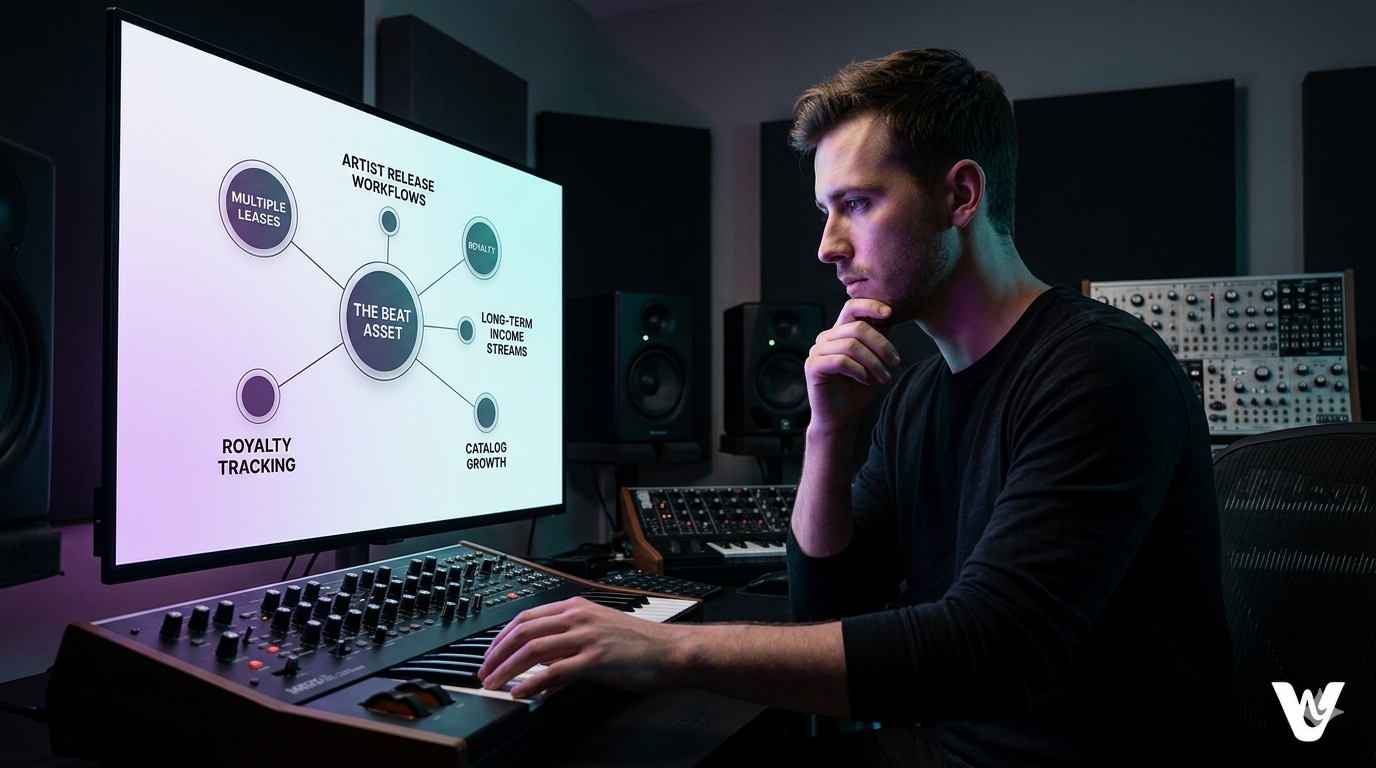
A beat is not just a file.
A beat can become an asset.
It can be leased, reused, released, credited, tracked, and connected to royalties. It can help build artist relationships. It can become part of multiple songs, multiple catalogs, and long-term music income.
This guide explains how producers can build recurring income from beats through leasing, royalties, catalog strategy, artist relationships, quality control, and release-ready music.
In This Guide
In this article, you’ll learn:
- why one-time beat sales are not enough
- what recurring income means for producers
- how beat leasing can support long-term income
- why producer royalties matter
- how a beat catalog can become an asset
- why quality control increases trust
- why artist relationships are more valuable than random buyers
- how Vesonus supports recurring producer income
- what producers should do to build a stronger catalog
Why One-Time Beat Sales Are Not Enough
Selling beats online changed the producer economy.
It gave producers a direct way to earn from their work without waiting for labels, managers, or placements.
That was powerful.
But the traditional beat-selling model has limits.
A producer uploads a beat.
An artist buys or leases it.
The producer gets paid.
The relationship often ends.
Then the producer has to start again.
This creates an income cycle that can feel unstable.
Common problems include:
- inconsistent monthly sales
- too much competition
- pressure to constantly upload
- low-price beat leases
- weak artist follow-up
- no backend royalties
- no long-term relationship with the artist
- no clear connection to the final release
The producer may have great music, but the business still depends on constant new attention.
That is exhausting.
One-time beat sales can be useful.
But they should not be the only path.
What Is Recurring Income for Producers?
Recurring income means money that continues over time instead of happening once.
For producers, recurring income can come from:
- recurring beat leases
- subscription-style access models
- royalty participation
- publishing income
- master royalty splits
- repeat artist relationships
- catalog performance
- long-term licensing opportunities
- producer services and future marketplace tools
The goal is not to replace every one-time sale.
The goal is to build a catalog that can keep working after the beat is uploaded.
That shift matters.
A one-time sale gives you income today.
A music asset can create income over time.
A Beat Can Become an Asset
A beat becomes more valuable when it is prepared for real use.
Not just previewed.
Used.
Recorded on.
Released.
Credited.
Tracked.
Connected to royalties.
Connected to future collaborators.
That is when the beat becomes part of a larger music business.
A beat is an asset when it has:
- clean audio
- proper stems
- accurate metadata
- clear licensing
- release-ready quality
- artist usability
- royalty structure
- long-term tracking
- repeat collaboration potential
This is the difference between uploading files and building a catalog.
A catalog is not just a folder of beats.
A catalog is a collection of music assets that can keep creating value.
Why Beat Leasing Supports Recurring Income
Beat leasing allows a producer to give artists permission to use a beat without giving away full ownership.
This is powerful because the same beat can potentially create income from more than one artist, depending on the license terms.
A non-exclusive beat can be leased multiple times.
That means one strong instrumental can support more than one release.
For producers, that can create income from:
- multiple leases
- recurring access
- future artist upgrades
- royalty participation
- publishing splits
- repeat buyers
- long-term relationships
The key is structure.
If leases are unclear, messy, or disconnected from releases, the producer may lose track of value.
If leases are clear and connected to a release workflow, the producer has a better chance of building income over time.
One Beat, Multiple Income Paths
A single beat can create value in several ways.
For example, one instrumental may generate:
- an upfront lease payment
- an exclusive license later
- recurring lease income
- producer royalty share
- publishing income
- master royalty participation
- future custom work from the same artist
- referrals from artists who used the beat
- placement opportunities from a stronger catalog
This is how producers should think.
Not:
How much can I sell this beat for today?
But:
How many ways can this track create value over time?
That is the mindset shift.
Why Royalties Matter for Producers
Royalties are where long-term income becomes real.
A producer can be paid upfront and still participate in the success of the song if the agreement allows it.
Producer royalties may include:
- master royalties
- publishing royalties
- producer points
- performance royalties
- streaming income
- sync or licensing income
The exact structure depends on the agreement between the artist and producer.
That is why clarity matters before release.
If the producer only earns once, they miss the upside if the song grows.
If the producer participates in royalties, the track can keep generating income as the release gains streams.
This does not mean every beat needs a complicated royalty deal.
It means producers should understand what they are giving away and what they are keeping.
Upfront Money vs Long-Term Value
Upfront money is simple.
An artist pays.
The producer earns.
The transaction ends.
Long-term value is different.
The producer may earn less immediately, but keep a share in the release.
That can matter if the song grows.
For example:
- a small lease can become a serious release
- a first-time artist can become a repeat collaborator
- a song can keep streaming for years
- a catalog can compound over time
- multiple releases can create a stronger royalty base
The strongest producer businesses often combine both:
Upfront income + long-term upside.
That is the goal.
Cash today.
Ownership tomorrow.
Catalog value over time.
Why Catalog Strategy Matters
Many producers think only about individual beats.
Better producers think about catalog strategy.
A strong catalog is not just a large number of uploads.
A strong catalog is organized, searchable, high-quality, and built for artist use.
A serious producer catalog should include:
- consistent quality
- clear genre direction
- accurate metadata
- strong file organization
- proper stems
- enough variety for artists
- release-ready mixes
- tracks with vocal space
- clear licensing options
- regular updates
The catalog should feel like a professional library.
Not a random dump of files.
Artists should be able to find what they need quickly.
If the artist experience is strong, the catalog becomes more valuable.
More Beats Is Not Always Better
Uploading more beats does not automatically create more income.
A large catalog with weak quality, bad metadata, poor stems, and unclear licensing can hurt the producer.
More is not the same as better.
A smaller catalog of well-prepared tracks can outperform a huge catalog of unfinished ideas.
Producers should ask:
- Are these beats actually ready for artists?
- Do the files work?
- Are the stems clean?
- Is there space for vocals?
- Are the tags accurate?
- Is the license clear?
- Would an artist trust this catalog?
- Would an engineer enjoy working with these files?
A producer catalog should be built like a business asset.
That means quality matters.
Why Quality Control Supports Income
Quality control is not only about sound.
It is about trust.
If artists trust the quality of a producer’s catalog, they are more likely to lease tracks, record songs, release music, and come back.
Quality control can help identify:
- poor audio quality
- no headroom
- harsh frequencies
- muddy low end
- bad stem exports
- wrong metadata
- unclear release readiness
- tracks that do not leave space for vocals
This matters because artists are not only buying sound.
They are buying confidence.
They need to know that the track can become a real release.
A beat that is easy to use is more valuable than a beat that only sounds good in a preview.
Artist Relationships Create Long-Term Value
Random buyers can create sales.
Relationships create careers.
A producer who builds relationships with artists can create more stable opportunities over time.
One artist may lease one beat.
A serious collaborator may lease five.
They may return for custom production.
They may credit the producer properly.
They may bring the producer into future releases.
They may share royalties.
They may refer other artists.
They may grow into a long-term creative partner.
That is much stronger than a one-time transaction.
Producers should not only ask:
How do I get more buyers?
They should ask:
How do I build better artist relationships?
That is where long-term income starts.
Why Release-Ready Beats Matter
A beat that sounds good alone is not enough.
A beat needs to work when an artist records on it.
That means:
- enough headroom
- clean stems
- controlled low end
- space for vocals
- clear arrangement
- proper export quality
- useful metadata
- clear license terms
Release-ready beats help artists move faster.
They reduce friction.
They make the producer look professional.
They also increase the chance that the song actually gets finished and released.
That matters.
A leased beat that never becomes a song has limited value.
A leased beat that becomes a release can create royalties, credit, attention, and long-term upside.
Why Producers Should Care About the Final Release
Some producers treat the beat sale as the finish line.
It is not.
The beat sale is the beginning.
The real value starts when the artist records, releases, and promotes the song.
That is where the producer’s work reaches listeners.
That is where royalties can begin.
That is where a catalog starts to grow beyond beat files.
Producers should care about whether the artist finishes the song because the final release can create:
- royalties
- exposure
- credits
- future collaborations
- stronger reputation
- more demand for the producer’s catalog
If the artist wins, the producer can win too.
That is the model independent music needs.
The Problem With Marketplace-Only Thinking
Beat marketplaces can be useful.
They help producers upload beats, set prices, and reach artists.
But marketplace-only thinking can become limiting.
If the whole strategy is based on marketplace traffic, producers are always dependent on:
- algorithms
- search visibility
- platform competition
- low prices
- constant promotion
- new buyers
- one-time transactions
That is not enough for long-term stability.
Producers need systems that connect beats to releases, royalties, quality control, and repeat collaboration.
They need more than traffic.
They need structure.
Where Vesonus Fits Into Recurring Producer Income
Vesonus is built around a different idea:
A producer’s track should not only be uploaded.
It should be prepared, quality-checked, leased, used in a release, connected to royalties, and tracked over time.
The Vesonus workflow is built around the full journey:
Producer uploads a finished instrumental.
Vesonus quality-checks the track.
Artist discovers and leases the track.
Artist records vocals.
The final song goes through quality control.
The release moves toward distribution.
Royalties are tracked and split.
Both creators can follow performance.
That is a stronger system than a simple beat transaction.
It connects the producer to the full life of the song.
Producers Keep Their Leasing Income
One of the most important parts of the Vesonus model is simple:
Producers keep 100% of leasing income.
Vesonus takes 0% of producer lease payments.
That matters because producers should be rewarded directly when artists lease their work.
Vesonus earns through subscriptions and a royalty share from released music, not by taking a cut from the producer’s leasing income.
This creates a better alignment.
The producer can earn from leases.
The artist gets access to release-ready tracks.
Vesonus earns when the released music performs.
That is cleaner than taking from every part of the creator relationship.
Royalties Create Long-Term Upside
After a release goes live, royalty structures become important.
On Vesonus, released music can be connected to royalty splits between the artist and producer.
This helps producers think beyond the first lease.
A track can become part of a real release.
That release can generate streaming revenue.
The producer can participate in the upside depending on the structure.
That is the difference between selling a file and participating in a song.
A file is downloaded once.
A song can keep earning.
Recurring Income Requires Professional Standards
Recurring income does not happen by accident.
It requires professional habits.
Producers need to treat their catalog seriously.
That means:
- uploading finished tracks
- preparing stems properly
- leaving headroom
- using accurate metadata
- organizing files clearly
- understanding licensing
- caring about release quality
- building artist relationships
- tracking performance
- thinking long term
The producers who win are not always the ones who upload the most.
They are the ones who build the most trusted catalog.
Trust creates leases.
Leases create releases.
Releases create royalties.
Royalties create long-term income.
How Producers Can Start Building Recurring Income
Here is the practical path.
1. Build a Strong Catalog
Start with your best tracks.
Do not upload everything.
Upload music that is actually ready for artists.
Focus on quality, clarity, and consistency.
2. Prepare Every Beat Properly
Make sure each track includes:
- full mix
- stems
- MP3 preview
- WAV file
- BPM
- key
- genre
- mood tags
- license information
The easier the beat is to use, the more valuable it becomes.
3. Leave Space for Artists
Do not make every beat so full that vocals have nowhere to sit.
A producer’s job is not only to impress.
It is to support the song.
4. Understand Licensing
Know the difference between:
- non-exclusive leases
- exclusive licenses
- upfront fees
- royalties
- publishing
- master splits
If you do not understand the deal, you cannot protect the value.
5. Think Beyond the First Sale
Ask what happens after the artist leases the beat.
Does the song get finished?
Does it get released?
Are you credited?
Are royalties clear?
Can the artist come back for more?
The real business starts after the first transaction.
6. Build Artist Relationships
Follow up.
Be professional.
Help artists understand your files.
Make collaboration easy.
A repeat artist is worth more than a random buyer.
7. Track What Works
Pay attention to which beats get attention, leases, releases, and repeat interest.
Your data tells you what the market responds to.
Use it.
8. Protect Your Brand
Every upload represents you.
Bad files damage trust.
Strong files build reputation.
Treat your catalog like a serious business asset.
Common Mistakes Producers Make
Many producers lose long-term income because they think too short term.
Common mistakes include:
- uploading unfinished beats
- over-limiting tracks
- not providing stems
- using weak metadata
- unclear licensing
- ignoring royalty conversations
- treating artists like one-time customers
- not tracking which beats were leased
- not following up after the sale
- focusing only on marketplace traffic
- pricing too low without a long-term plan
The biggest mistake is this:
Thinking the beat sale is the end.
It is not.
It is the start of the song’s life.
Why Recurring Income Is About Ownership
Recurring income is not only about more money.
It is about ownership.
Producers create value. They should not be forced into systems where their work is treated like disposable content.
A beat can be part of a song.
A song can be part of a catalog.
A catalog can become income.
Income can become stability.
Stability gives creators freedom.
That is the bigger picture.
The future of music should not be built only around quick sales and platform traffic.
It should be built around creators owning more of the value they create.
Your sound.
Your catalog.
Your future.
Final Thoughts
Producers do not need to stop selling beats.
But they should stop thinking only in one-time sales.
A beat can be more than a file.
It can become a lease.
A release.
A royalty stream.
A relationship.
A catalog asset.
A long-term income opportunity.
That is the shift.
The producers who build sustainable careers will not only upload more beats.
They will build better catalogs, clearer licenses, stronger artist relationships, cleaner files, better releases, and long-term royalty opportunities.
That is how producers move from chasing sales to building income.
Vesonus is building a platform for that future — where producers can upload release-ready tracks, keep their leasing income, collaborate with artists, participate in royalties, and build long-term value from their catalog.
Create. Release. Own.
Next step
Ready to build long-term income from your catalog?
Vesonus helps producers turn finished tracks into lease-ready, quality-controlled music assets built for collaboration, releases, royalties, and long-term income.
Join Vesonus