
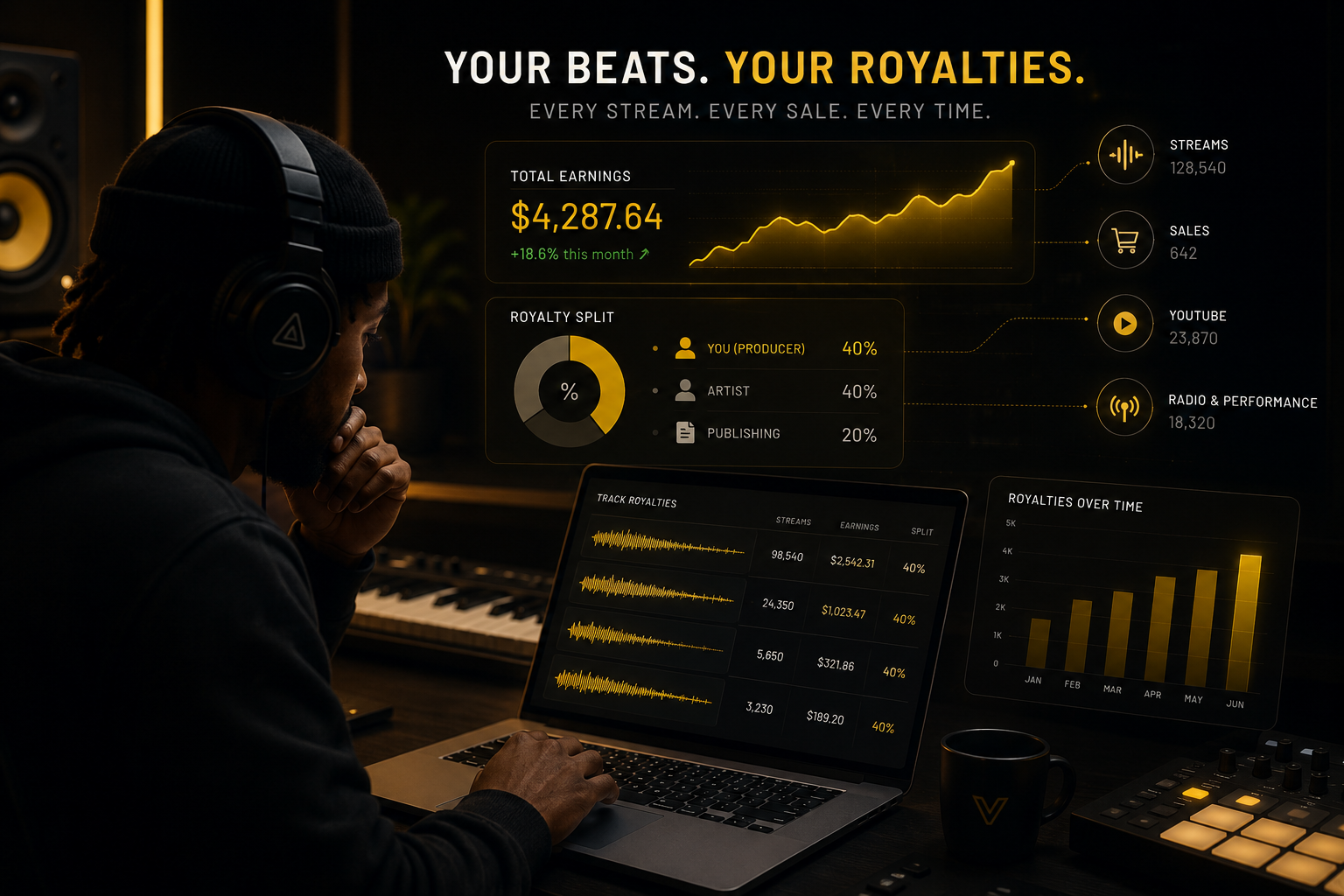
How Producer Royalties Work After a Beat Release
Learn how producer royalties work when an artist releases your beat, including upfront payments, master royalties, publishing splits, producer points, and why clear agreements matter before release.
Producer royalties can be confusing, especially when a beat moves from a marketplace or private sale into an actual song release.
A producer may sell a beat, lease a beat, keep publishing, share master royalties, receive producer points, or earn from recurring payments depending on the agreement. For artists, it can be just as confusing. Many artists think paying for a beat means the producer is fully paid and has no future rights. In many cases, that is not true.
If you are a producer selling beats online, understanding royalties is one of the most important parts of building a real music business.
This guide explains how producer royalties work when an artist releases your beat, what different types of royalties mean, and why clear agreements should be handled before the song goes live.
In This Guide
In this article, you’ll learn:
- what producer royalties are
- how producers make money from released songs
- the difference between upfront fees and backend royalties
- what master royalties are
- what publishing royalties are
- what producer points mean
- how beat licenses and royalties connect
- common royalty mistakes producers make
- common royalty mistakes artists make
- how Vesonus is building around clearer royalty structures
What Are Producer Royalties?
Producer royalties are payments a producer may receive when a song they helped create earns revenue.
This can happen when the song is streamed, sold, performed, licensed, or monetized in other ways.
A producer can earn money from a song in several different ways, including:
- upfront beat lease payments
- exclusive license fees
- recurring lease payments
- master royalty splits
- publishing royalties
- producer points
- performance royalties
- sync or licensing income
The exact structure depends on the agreement between the producer and the artist.
This is why it is important to understand that selling a beat and earning royalties are not always the same thing.
A producer can be paid upfront and still keep royalty rights. A producer can also sell a beat for a one-time fee with no backend income. Both are possible, but the agreement needs to be clear.
Upfront Payment vs Backend Royalties
The simplest way a producer gets paid is through an upfront payment.
For example, an artist might pay:
- $30 for a basic beat lease
- $100 for a premium lease
- $500 for an exclusive license
- $2,000 for custom production
That payment is usually made before the song is released.
Backend royalties are different. Backend royalties are earned after the song starts generating revenue.
For example, if the song earns money from Spotify, Apple Music, YouTube, TikTok, radio, sync licensing, or other sources, the producer may receive a percentage depending on the agreement.
In simple terms:
Upfront payment = money paid before release.
Backend royalties = money earned after release.
Both can matter.
A producer who only charges upfront may get paid quickly, but they may miss out if the song becomes successful later.
A producer who keeps backend rights may earn less upfront, but they can benefit if the song performs well over time.
Does a Beat Lease Include Royalties?
Sometimes yes. Sometimes no.
A beat lease is a license that gives an artist permission to use a beat under specific terms.
The license may include royalty terms, but it does not always do so clearly.
This is where many misunderstandings happen.
An artist might think:
“I paid for the beat, so I own the song revenue.”
A producer might think:
“I made the beat, so I should receive royalties.”
Both sides may be partly right depending on the agreement.
That is why every beat license should clearly explain:
- what the artist paid for
- what rights the artist receives
- whether the producer keeps publishing
- whether the producer receives master royalties
- whether the producer receives producer points
- whether the artist can monetize the song
- how future income is split
- what happens if the song performs well
A beat license should not only explain usage rights. It should also explain money.
What Are Master Royalties?
Master royalties are connected to the sound recording.
When an artist records vocals over a beat and releases the final song, that released audio file is the master recording.
If the song earns money from streaming or sales, that income is usually connected to the master.
Master income may come from:
- Spotify streams
- Apple Music streams
- YouTube monetization
- digital downloads
- physical sales
- neighboring rights
- certain licensing uses
Depending on the agreement, the producer may or may not share in the master royalties.
For example, an agreement might say:
- artist keeps 100% of master royalties
- producer receives 10%
- producer receives 20%
- producer and artist split master royalties 50/50
- producer receives producer points instead of a direct split
There is no single universal structure.
The important thing is that both sides agree before the release goes live.
What Are Publishing Royalties?
Publishing royalties are connected to the composition of the song.
The composition is the underlying musical work: melody, harmony, lyrics, and musical ideas.
If a producer created the instrumental, they may be considered one of the writers or composers of the song. If the artist wrote the lyrics and vocal melody, the artist may also own part of the composition.
Publishing income can come from:
- performance royalties
- mechanical royalties
- radio play
- live performances
- public use
- certain streaming royalties
- sync licensing
- covers or reproductions
This is why publishing splits are important.
A producer who created the beat may keep a publishing share even if the artist paid for a license.
For example, a song split might look like:
| Contributor | Publishing Share | |---|---:| | Artist / lyric writer | 50% | | Producer / composer | 50% |
Or:
| Contributor | Publishing Share | |---|---:| | Artist | 60% | | Producer | 40% |
Or:
| Contributor | Publishing Share | |---|---:| | Artist | 75% | | Producer | 25% |
The right split depends on the creative contribution and the agreement.
The mistake is not choosing one structure or another. The mistake is leaving it unclear.
Master Royalties vs Publishing Royalties
Master royalties and publishing royalties are often confused.
Here is the simple difference:
| Type | Connected To | Example Income | |---|---|---| | Master royalties | The final sound recording | Streaming master revenue, downloads, YouTube monetization | | Publishing royalties | The underlying composition | Songwriting, composition, performance and mechanical royalties |
A producer can participate in one, both, or neither depending on the agreement.
For example:
- A producer may keep publishing but receive no master royalties.
- A producer may receive master points but no publishing.
- A producer may receive both master and publishing shares.
- A producer may sell all rights for a higher upfront fee.
This is why producers and artists need to separate the conversation.
Do not only ask:
Who gets paid?
Ask:
Paid from what source?
What Are Producer Points?
Producer points are a percentage of revenue from the master recording.
One point usually means one percent.
For example, if a producer receives 3 points, that usually means the producer receives 3% of certain master revenue.
Producer points are common in parts of the music industry, especially in label deals, but independent releases can also use similar structures.
The challenge is that “points” can mean different things depending on the contract.
Important questions include:
- Are the points based on gross revenue or net revenue?
- Are costs deducted first?
- Which platforms are included?
- When does payment begin?
- How often is the producer paid?
- Is the producer also keeping publishing?
- Are the points permanent?
Again, clarity matters.
A percentage is only useful if both sides understand what the percentage applies to.
Can a Producer Earn Both an Upfront Fee and Royalties?
Yes.
A producer can earn an upfront fee and still keep royalty rights if the agreement allows it.
For example, a producer could receive:
- a $100 lease fee
- 50% publishing share
- 10% master royalty
- producer credit
Or:
- a $1,000 exclusive license fee
- 25% publishing share
- no master royalty
Or:
- no upfront fee
- 50% master royalty
- 50% publishing share
There are many possible structures.
The best model depends on the situation.
If the artist has a low budget, the producer may accept a smaller upfront payment in exchange for backend royalties.
If the artist wants more control, the producer may charge a higher upfront fee.
If both sides believe in the release, they may choose a more collaborative royalty split.
The key is to agree before release.
What Happens If the Song Becomes Successful?
This is where unclear royalty agreements become dangerous.
When a song has only a few streams, nobody may care much about the details.
But if the song starts performing well, small misunderstandings become bigger problems.
A producer may ask:
“Where is my royalty share?”
An artist may respond:
“I already paid for the beat.”
Both sides may feel they are right.
This is why agreements should be clear before the song is released, not after it starts gaining traction.
Before release, both sides should know:
- who owns the master
- who owns the composition
- who receives publishing
- who receives master royalties
- who is credited as producer
- who controls distribution
- who collects income
- how payments are reported
- what happens if a label, manager, or distributor gets involved later
A song performing well should be a good thing.
It should not become the moment where the business side falls apart.
Common Royalty Structures for Producers
There is no one-size-fits-all royalty structure, but here are some common examples.
1. Upfront Only
The artist pays the producer once.
The producer receives no backend royalties.
This is simple, but the producer has no long-term upside if the song grows.
2. Upfront Fee + Publishing
The artist pays for the beat, and the producer keeps a share of publishing.
This is common when the producer contributed to the composition.
3. Upfront Fee + Master Royalty
The producer receives payment upfront and also earns a percentage of master income.
This gives the producer both immediate and long-term income potential.
4. Royalty Split Only
No upfront payment. The producer and artist split future revenue.
This can work when both sides are collaborating closely, but it is riskier because payment depends on the song actually earning money.
5. Recurring Lease + Royalty Structure
Instead of only selling a one-time license, the producer earns from an ongoing lease model and may also participate in release income.
This type of structure is especially interesting for independent music because it can create more predictable income over time.
Why Producers Should Think Beyond One-Time Sales
One-time beat sales can be useful, but they are not always enough to build a sustainable producer business.
A producer who relies only on one-time sales has to keep finding new buyers constantly.
That can become exhausting.
The producer is always chasing:
- new traffic
- new artists
- new uploads
- new promotions
- new marketplace visibility
Royalties change the mindset.
Instead of only asking:
How much can I sell this beat for today?
A producer can start asking:
How can this track create value over time?
That is a more business-focused way to think about music production.
A beat is not just a file. It can become part of a release, a catalog, a collaboration, and a long-term income stream.
Common Mistakes Producers Make With Royalties
Many producers lose money because they do not treat royalties seriously early enough.
Common mistakes include:
- not discussing royalty splits before release
- assuming they automatically keep publishing
- selling exclusive rights without understanding what they gave away
- not keeping written agreements
- not registering songs properly
- not tracking which artist leased which beat
- not knowing the difference between master and publishing
- not asking how the song will be distributed
- not keeping proof of ownership
- not thinking long term
The biggest mistake is waiting until a song performs well before discussing money.
By then, the conversation becomes much harder.
Common Mistakes Artists Make With Producer Royalties
Artists can also misunderstand royalties.
Common mistakes include:
- assuming a beat purchase removes all producer rights
- not reading the license
- not asking about publishing splits
- not crediting the producer correctly
- not telling the producer when the song is released
- uploading the song without correct contributor information
- ignoring royalty registration
- assuming exclusive rights mean full ownership
- not keeping a copy of the license agreement
- not clarifying who controls the master
Artists should not see this as a burden.
Clear producer agreements protect the artist too.
If a song starts growing, the artist needs to know that the rights are clean, the splits are clear, and the release will not create unnecessary conflict.
Why Royalty Clarity Builds Better Collaboration
Music is becoming more collaborative.
Artists, producers, songwriters, engineers, and marketers often work together across countries, time zones, and platforms.
That creates opportunity, but it also creates complexity.
The more people involved in a song, the more important clear agreements become.
Royalty clarity helps everyone understand:
- what they contributed
- what they own
- how they get paid
- what happens after release
- how future opportunities are handled
This makes collaboration easier.
It also makes the music more professional.
When the business side is clear, creators can focus more on the song.
Where Vesonus Fits Into Producer Royalties
Vesonus is being built around the idea that music creation should not stop at the beat transaction.
Traditional beat marketplaces often focus on the sale or lease.
A producer uploads a beat.
An artist buys or leases it.
The relationship often ends there.
But the real music business starts after that.
The artist records vocals.
The song goes through quality control.
The release is prepared.
The song is distributed.
Royalties need to be tracked.
Both sides need to understand how income is shared.
Vesonus is designed around this fuller workflow.
The goal is to help producers and artists work with clearer structures around:
- beat leasing
- collaboration
- quality control
- release preparation
- royalty sharing
- long-term income
That is a different approach from only selling beats as one-time files.
Why Recurring Producer Income Matters
Many producers want more stable income from music.
One-time sales can help, but they are unpredictable.
Some months may be good. Other months may be slow.
Recurring models can help producers think differently about their catalog.
Instead of every beat being a one-time sale, a track can potentially become part of an ongoing income system.
This matters because producers are not only creating files. They are creating assets.
A strong instrumental can support multiple artists, multiple releases, and multiple income opportunities depending on how the licensing model is built.
That is why Vesonus is focused on long-term creator value, not only short-term transactions.
What Producers Should Clarify Before Release
Before an artist releases a song using your beat, clarify:
- Is the license non-exclusive or exclusive?
- Who owns the beat?
- Who owns the final master?
- What publishing share does the producer keep?
- Does the producer receive master royalties?
- Are there producer points?
- What platforms can the song be released on?
- Who controls distribution?
- How will the producer be credited?
- How will royalties be tracked?
- How often will payments be reported?
- What happens if the song gets signed later?
- What happens if the artist wants to upgrade the license?
These questions may feel detailed, but they protect both sides.
A serious release deserves a serious agreement.
What Artists Should Clarify Before Release
Artists should also ask questions before releasing a song with a leased beat.
Important questions include:
- Did I buy a license or full ownership?
- Can I release the song commercially?
- Can I monetize it on YouTube and TikTok?
- Are there stream limits?
- Does the producer keep publishing?
- Does the producer receive master royalties?
- Do I need to credit the producer in the title or metadata?
- Can I register the song with my distributor?
- Can I pitch the song to playlists?
- Can I run paid ads?
- Can I perform the song live?
- Can I upgrade to exclusive rights later?
The goal is not to make the process complicated.
The goal is to avoid confusion later.
Producer Royalties Are Part of the Future of Independent Music
Independent music is growing because artists no longer need a traditional label to release music.
But independence also means creators need to understand the business side better.
Producers need to know how their beats generate value.
Artists need to know what rights they are buying.
Both sides need clear agreements before music goes live.
The future of independent music will not only be about access to tools. It will be about better systems for collaboration, rights, quality, royalties, and long-term income.
That is exactly the space Vesonus is building for.
Final Thoughts
Producer royalties are not just a technical detail.
They define how producers participate in the success of the music they help create.
An upfront beat payment can be useful. An exclusive license can be valuable. A publishing share can create long-term income. A master royalty split can give producers upside after release. A recurring lease model can make a producer catalog more sustainable.
None of these models are automatically right or wrong.
What matters is clarity.
Before a song is released, the producer and artist should understand:
- what was paid upfront
- who owns the beat
- who owns the final recording
- who receives publishing
- who receives master royalties
- how the producer is credited
- how income is tracked
- what happens if the song grows
When this is clear, both sides can focus on what actually matters: making great music and building long-term careers.
Vesonus is building a platform around that future — where producers and artists can lease, collaborate, release, and earn with more transparency from the start.
To learn more about how Vesonus is approaching royalties and creator income, explore the royalty model:
Next step
Ready to build music income with clearer royalty splits?
Vesonus helps producers and artists lease tracks, prepare releases, and build clearer royalty structures before the music goes live.
Join Vesonus