
BeatStars vs Vesonus: What’s the Difference for Producers?
Compare BeatStars and Vesonus from a producer perspective, including beat selling, licensing, royalties, quality control, recurring income, and long-term collaboration with artists.
BeatStars is one of the most recognized platforms in the online beat-selling world. For many producers, it has been the default place to upload beats, create a store, set license prices, and reach artists looking for instrumentals.
Vesonus is different.
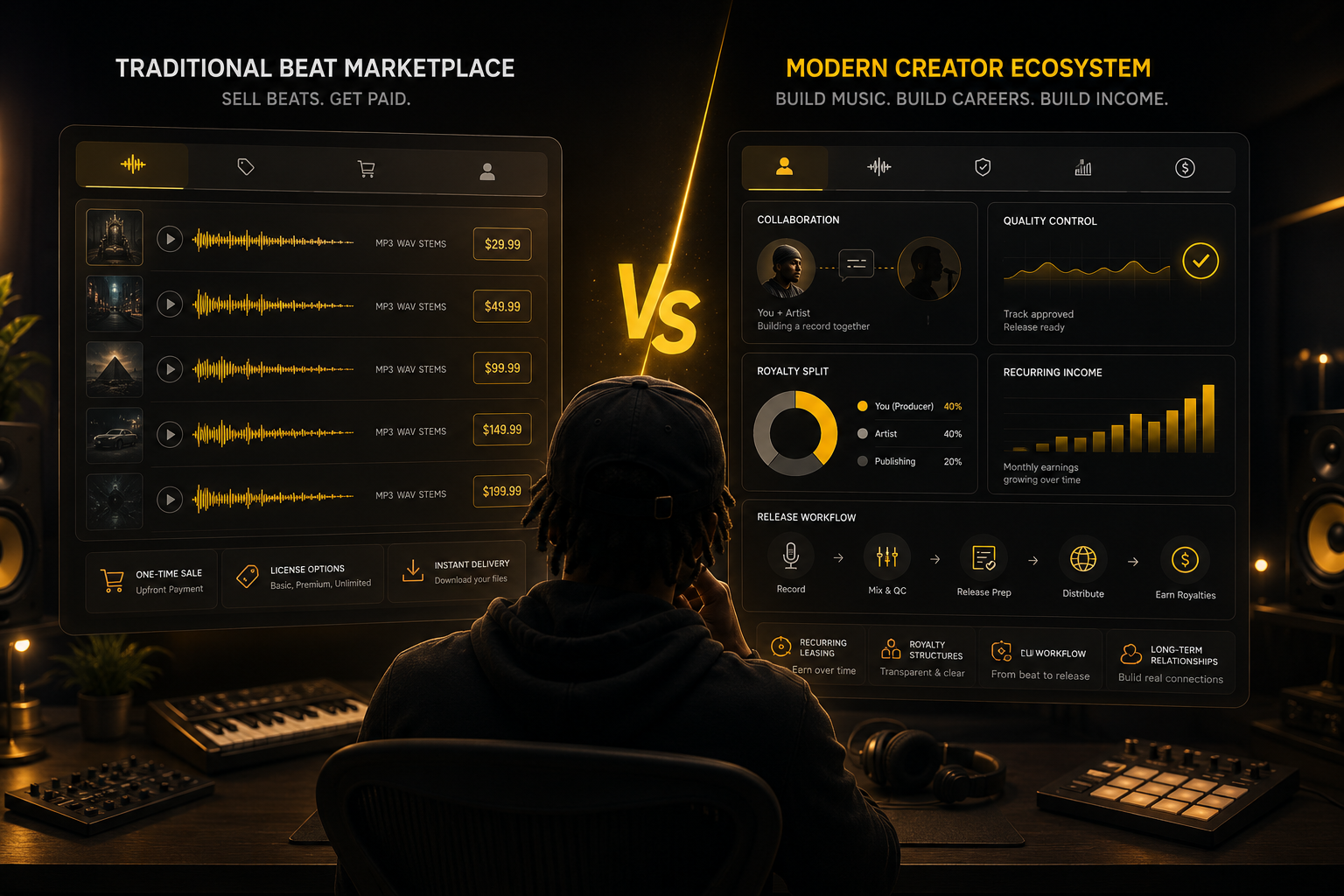
BeatStars is mainly known as a beat marketplace. Vesonus is a creator-first music platform built around collaboration, quality control, release preparation, royalty clarity, and long-term income — without asking creators to give away ownership.
This comparison explains the difference between BeatStars and Vesonus from a producer perspective.
The goal is not to say that one platform is “good” and the other is “bad.” They solve different problems.
BeatStars helps producers sell beats.
Vesonus helps producers turn finished tracks into release-ready collaborations, clearer royalty structures, and long-term income opportunities.
In This Guide
In this article, you’ll learn:
- what BeatStars is
- what Vesonus is
- how the platforms differ for producers
- how beat selling compares to release-building
- why recurring income matters
- why quality control matters
- how royalties and release workflows fit in
- why ownership is central to the Vesonus model
- which platform may fit different producer goals
- why Vesonus is building beyond the traditional marketplace model
What Is BeatStars?
BeatStars is a digital production marketplace where music producers can license, sell, and give away beats.
For many producers, BeatStars is useful because it gives them a place to upload tracks, create licenses, accept payments, and reach artists who are already searching for beats.
A typical BeatStars workflow looks like this:
- A producer uploads a beat.
- The producer sets license options.
- An artist finds the beat.
- The artist buys or leases the beat.
- The artist downloads the files.
- The producer gets paid according to the sale or license terms.
This is a familiar model in the beat-selling economy.
BeatStars is especially useful for producers who want a recognizable marketplace, a storefront, and a direct system for selling beats to artists.
What Is Vesonus?
Vesonus is built for producers and artists who want more than a traditional beat marketplace.
The goal is to connect the full independent music workflow in one platform.
For producers, Vesonus is designed around:
- uploading finished, radio-ready instrumentals
- leasing tracks to artists
- building recurring income opportunities
- helping artists move from beat discovery to release
- using technical quality control before music moves forward
- supporting clearer royalty structures
- connecting licensing, release preparation, and monetization
In simple terms:
BeatStars helps producers sell beats.
Vesonus helps producers turn tracks into release-ready collaborations and long-term music assets.
That difference matters.
Because a beat is not only a file. It can become a song, a release, a royalty stream, and a long-term creative relationship.
BeatStars vs Vesonus: Quick Comparison
| Feature | BeatStars | Vesonus | |---|---|---| | Main focus | Beat marketplace | Creator workflow | | Producer role | Beat seller | Creator, collaborator, rights participant | | Artist role | Beat buyer or licensee | Release partner | | Core model | Beat sales and licenses | Leasing, collaboration, QC, release support, royalties | | Beat selling | Yes | Yes, through a leasing-focused model | | Non-exclusive licensing | Yes | Yes | | Exclusive licensing | Yes | Yes | | Recurring income focus | Not the core model | Built into the model | | Quality control | Not central to the model | Built into the workflow | | Release workflow | Mostly outside the platform | Connected to the platform vision | | Royalty clarity | Depends on external agreements | Designed around clearer automated splits | | Ownership | Depends on user agreements | Creators keep ownership | | Best for | Traditional beat selling | Long-term creator collaboration |
This does not mean every producer should use one and not the other.
It means the platforms are built around different ideas.
BeatStars is built around the beat transaction.
Vesonus is built around what happens before, during, and after that transaction.
The Main Difference: Selling Beats vs Building Releases
The biggest difference between BeatStars and Vesonus is the depth of the workflow.
BeatStars is mainly built around beat discovery and beat transactions.
A producer uploads music.
An artist finds it.
A license is purchased.
The files are downloaded.
That model works well for many producers.
But it often leaves the rest of the music journey outside the platform.
After the beat is leased, the artist still needs to:
- record vocals
- mix the song
- handle release preparation
- clarify royalties
- distribute the song
- promote the release
- report income
- manage future splits
Vesonus is built around the idea that the beat transaction is only the beginning.
The real value starts when the beat becomes a finished song.
That is where producers move beyond simple sales and become part of a larger release journey.
Beat Selling vs Long-Term Producer Income
Traditional beat marketplaces often focus on one-time payments.
A producer sells a lease or exclusive license, gets paid, and then moves on to the next buyer.
That can work.
But it creates a challenge:
The producer has to keep chasing new sales.
That means constantly trying to get:
- more traffic
- more views
- more clicks
- more marketplace visibility
- more artist attention
- more repeat buyers
Vesonus is built around a different question:
What if a producer’s catalog could create more stable income over time?
Instead of only thinking:
How much can I sell this beat for today?
A producer can start thinking:
How can this track keep creating value after it is leased?
That shift matters.
A strong instrumental is not just a file. It can become part of multiple releases, relationships, royalty structures, and long-term income opportunities.
Why Recurring Leasing Matters
Recurring leasing is one of the biggest differences in how Vesonus thinks about producer income.
In a traditional model, an artist may pay once for a license.
In a recurring model, the producer can earn from ongoing access or use.
This can make producer income more predictable over time.
For example, instead of relying only on one-time beat sales, a producer may build a catalog where several tracks generate smaller recurring payments.
Individually, each payment may be modest.
Together, they can become a more stable income base.
This is important because most producers do not struggle only because they lack talent.
They struggle because their income is inconsistent.
Vesonus helps producers think more like music entrepreneurs, not only beat sellers.
Quality Control: A Key Vesonus Difference
One of the biggest problems in online beat marketplaces is inconsistent quality.
Some beats are professionally mixed and ready for vocals.
Others may have issues like:
- too much limiting
- poor headroom
- muddy low end
- harsh high frequencies
- unbalanced drums
- weak stereo image
- stems that are hard to use
- export problems
For artists, this can be frustrating.
They may lease a beat, record vocals, and only later discover that the instrumental does not work well in a final mix.
For producers, quality control is also valuable.
A producer may have strong ideas but still need technical feedback to make the track more release-ready.
This is where Vesonus is different.
Vesonus includes technical quality control as part of the platform workflow.
The point is not to judge taste, genre, vibe, or creativity.
The point is to help make sure tracks meet a stronger technical standard before they move through the release process.
That can help:
- producers improve their catalog
- artists trust the music they lease
- releases sound more professional
- the platform maintain a higher standard
- creators avoid problems later in the process
In other words, Vesonus is not only asking:
Can this beat be sold?
It is asking:
Is this track ready to become part of a serious release?
That is a major difference.
From One-Time Buyers to Real Collaborators
On a traditional beat marketplace, the artist is often treated like a buyer.
They search, listen, purchase, download, and leave.
That is simple and efficient, but it can also limit the relationship.
Many producers do not just want random one-time buyers.
They want artists who:
- come back for more tracks
- release serious music
- credit them properly
- respect the agreement
- share royalties clearly
- build a long-term creative relationship
Vesonus is built around this kind of longer-term collaboration.
The goal is not only to help artists find beats.
The goal is to help artists and producers move from discovery to release in a more structured way.
That changes the producer’s role.
The producer is not just selling a file.
The producer becomes part of the song’s journey.
Royalties and Splits
Royalties are one of the most important parts of producer income.
A producer may earn from:
- upfront lease payments
- exclusive license fees
- recurring lease payments
- master royalties
- publishing royalties
- producer points
- streaming revenue
- performance income
On many traditional marketplace models, the royalty side depends heavily on what the producer sets up, what the artist understands, and what both sides agree to outside the platform.
This can work, but it often creates confusion.
Artists may think paying for a beat means they own everything.
Producers may think they automatically keep publishing or backend royalties.
Both sides may be wrong depending on the agreement.
Vesonus is designed with royalty clarity as a core part of the creator workflow.
The goal is to make it easier for both sides to understand:
- who owns what
- who gets paid
- how income is shared
- what happens after release
- how the producer participates long term
This is especially important as more independent artists release music without labels.
Without a label, the artist and producer need better systems.
They need clarity before the song goes live.
Ownership: The Difference That Matters
For producers and artists, the platform is only part of the question.
The bigger question is ownership.
Traditional music systems often give creators access to opportunity in exchange for control.
Vesonus is built differently.
Creators keep ownership of their music.
Producers keep their leasing income.
Vesonus earns through subscriptions and a royalty share tied to released music performance — not by taking creator rights.
That matters.
Because the future of independent music should not be built on creators giving away the thing they came to build.
Your music.
Your rights.
Your career.
That is the difference Vesonus is fighting for.
Distribution and Release Support
Another major difference is what happens after the beat is leased.
In a traditional beat marketplace, the platform usually helps with the beat transaction.
But the release often happens somewhere else.
The artist may use a distributor, hire an engineer, create artwork, plan content, and try to market the release alone.
Vesonus is built with a broader release vision.
The goal is to connect more of the independent release process, including:
- quality control
- release preparation
- distribution support
- royalty structures
- marketing planning
- long-term tracking
This matters because music success does not come from the beat alone.
It comes from the full release.
A great beat that is never properly recorded, mixed, distributed, or promoted may never reach its potential.
Vesonus is built around that bigger picture.
Which Platform Is Better for Producers?
The honest answer depends on what the producer wants.
BeatStars may be a better fit if you want:
- a known beat marketplace
- direct beat selling tools
- a familiar artist buyer ecosystem
- a simple storefront for beats
- a traditional license-based sales model
Vesonus may be a better fit if you want:
- a platform built around long-term collaboration
- recurring leasing opportunities
- quality control feedback
- clearer release and royalty structures
- a broader independent music workflow
- a platform focused on artists and producers building songs together
- a creator-first model where ownership stays with the creators
This is not necessarily an either-or decision.
Some producers may use BeatStars for traditional beat sales while exploring Vesonus for a more collaborative and release-focused model.
The key is understanding what each platform is built to do.
BeatStars is built for selling beats.
Vesonus is built for turning music into releases, relationships, and long-term creator income.
Why Producers Should Not Only Think About Marketplace Traffic
Many producers focus only on marketplace traffic.
That makes sense at first.
More traffic can mean more potential buyers.
But traffic alone does not build a sustainable producer business.
A producer also needs:
- strong sound quality
- clear licensing
- good metadata
- a professional profile
- repeat artist relationships
- royalty awareness
- release-ready tracks
- long-term income systems
This is why Vesonus approaches the problem differently.
The question is not only:
Where can I upload beats?
The bigger question is:
What kind of producer business am I building?
If the goal is quick transactions, a marketplace can help.
If the goal is long-term income, collaboration, royalties, and professional releases, producers need more than a marketplace.
They need a system.
BeatStars Alternatives: Why Producers Are Looking for New Models
Many producers search for BeatStars alternatives because they are not only looking for another place to upload beats.
They are looking for a better model.
Common reasons producers explore alternatives include:
- too much competition
- difficulty standing out
- inconsistent sales
- lack of recurring income
- weak artist follow-up
- unclear royalty structures
- limited connection to the release process
- desire for a more professional ecosystem
Vesonus is not trying to copy the traditional beat marketplace model.
It is expanding what a producer platform can be.
That is the important distinction.
A better alternative is not always the same thing with different branding.
Sometimes the better alternative is a new workflow.
The Future: From Beat Stores to Creator Ecosystems
The online beat economy helped producers monetize music in a new way.
That was important.
But the next stage of independent music is bigger than beat stores.
Producers and artists need systems that help them:
- discover each other
- license music clearly
- check technical quality
- collaborate remotely
- prepare releases
- distribute music
- understand royalties
- build recurring income
- grow careers without traditional labels
That is the future Vesonus is building toward.
Not just a place to sell beats.
A platform for independent music creation, collaboration, release, and monetization.
Final Thoughts
BeatStars and Vesonus are built around different ideas.
BeatStars is a well-known beat marketplace where producers can license and sell beats to artists.
Vesonus is built around a wider vision: helping producers and artists collaborate, lease tracks, check quality, prepare releases, manage royalties, and build long-term income — while keeping ownership with the creators.
If you are a producer who wants a traditional beat store, BeatStars may make sense.
If you are a producer who wants to be part of a broader independent music workflow, Vesonus may be closer to the future you are looking for.
The most important question is not only where you can sell beats.
The better question is:
What happens after your beat becomes a song?
That is where Vesonus is focused.
Vesonus is building the next workflow for independent creators: lease the track, shape the song, pass quality control, release professionally, and earn with clearer splits.
Join Vesonus and become part of the early creator community.
Next step
Want more than a traditional beat marketplace?
Vesonus helps producers move beyond one-time beat sales with leasing, collaboration, quality control, release support, and clearer royalty structures.
Join Vesonus