
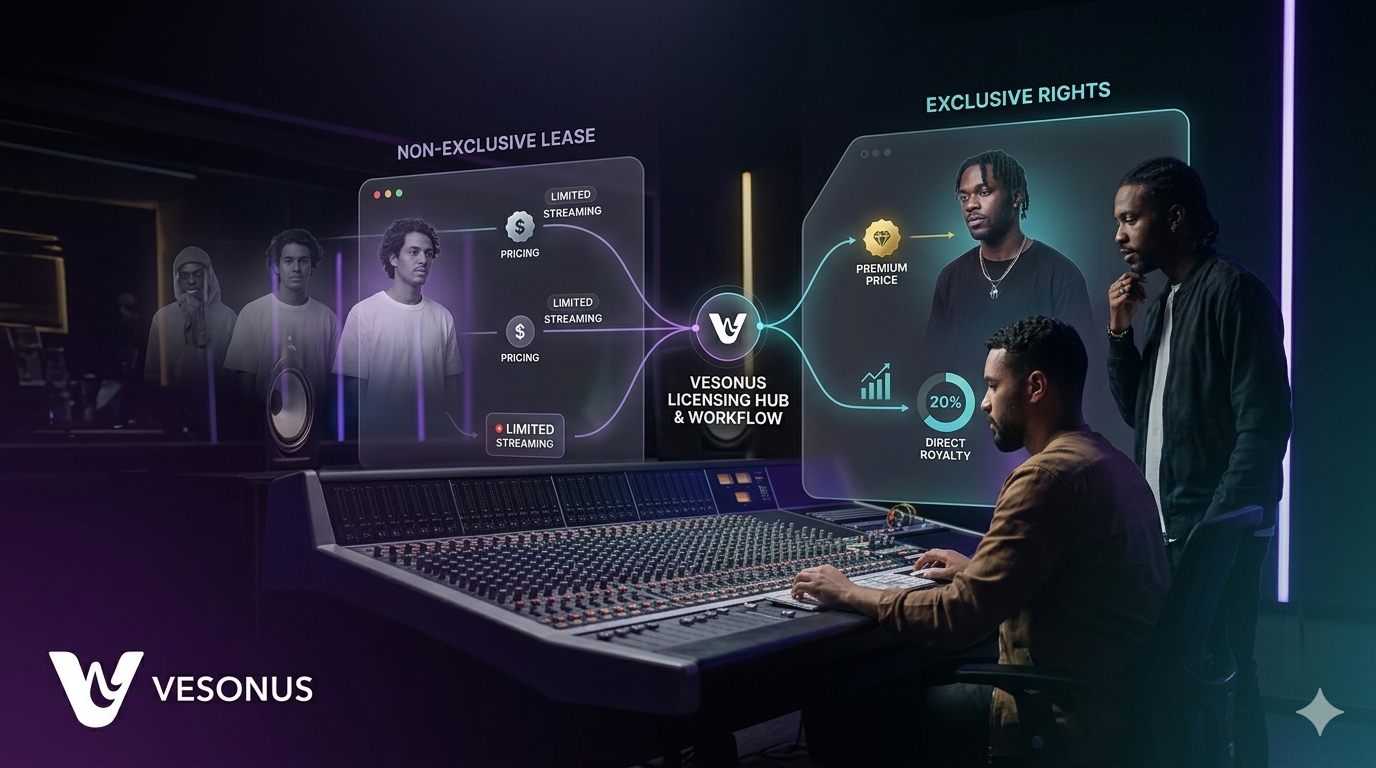
Beat Licensing Explained: Non-Exclusive vs Exclusive Beats
Learn how beat licensing works, including non-exclusive leases, exclusive rights, royalties, ownership, stream limits, and what artists and producers should understand before releasing music.
Beat licensing is one of the most important parts of the modern music business, but it is also one of the most misunderstood.
Many artists think that buying a beat means they own it completely. Many producers sell licenses without clearly explaining what the artist is allowed to do. This creates confusion around ownership, royalties, release rights, streaming limits, exclusivity, and what happens if a song starts performing well.
If you are a producer trying to sell beats online, or an artist looking for instrumentals to release, understanding beat licensing is essential.
This guide explains how beat licensing works, the difference between non-exclusive and exclusive beats, how royalties usually fit into the agreement, and what both artists and producers should know before releasing music.
In This Guide
In this article, you’ll learn:
- what beat licensing means
- how non-exclusive beat licenses work
- how exclusive beat licenses work
- whether buying a beat means owning it
- how royalties and publishing can work
- common mistakes artists make
- common mistakes producers make
- why clear licensing matters for independent music
- how Vesonus is approaching beat leasing differently
What Is Beat Licensing?
Beat licensing is the process where a producer gives an artist permission to use an instrumental under specific terms.
In most cases, the producer is not selling full ownership of the beat. Instead, the producer is giving the artist a license to record vocals, release a song, monetize that song, and use the instrumental in certain ways.
The license usually explains things like:
- whether the beat is exclusive or non-exclusive
- which files the artist receives
- whether stems are included
- how many streams or sales are allowed
- whether the artist can release the song commercially
- whether the producer keeps ownership
- whether royalties are shared
- whether the artist can upload the song to Spotify, Apple Music, YouTube, TikTok, and other platforms
In simple terms, a beat license answers this question:
What is the artist allowed to do with the producer’s instrumental?
That is why clear licensing matters. Without it, both sides can misunderstand the deal.
Does Buying a Beat Mean You Own It?
Usually, no.
Buying or leasing a beat normally means buying permission to use it, not full ownership of the original instrumental.
This is one of the biggest misunderstandings in beat licensing.
When an artist pays for a beat, they are usually buying a usage license. That means the producer still owns the instrumental, while the artist receives permission to record a song with it and release that song under the rules of the license.
There are exceptions. In some cases, a producer may sell full ownership or transfer all rights. But that is not the standard beat marketplace model, and it usually costs significantly more.
Most beat purchases fall into one of two categories:
- non-exclusive beat license
- exclusive beat license
To understand the difference, we need to look at both.
What Is a Non-Exclusive Beat License?
A non-exclusive beat license allows an artist to use a beat, but the producer can still license the same beat to other artists.
This is one of the most common models in online beat selling.
For example, a producer uploads a beat to a marketplace. One artist leases it for a song. Later, another artist may also lease the same beat for a different song. Both artists can use the beat, as long as they follow the terms of their license.
That is why it is called non-exclusive.
The artist does not receive exclusive control over the beat. They receive permission to use it.
Why Artists Use Non-Exclusive Beats
Non-exclusive licenses are popular because they are usually more affordable.
They allow independent artists to release music without paying hundreds or thousands of dollars upfront for exclusive rights.
For new artists, this can be a smart way to:
- test new sounds
- release more music
- work with different producers
- build a catalog
- avoid large upfront costs
A non-exclusive beat can still be used for serious releases, as long as the artist understands the license terms.
Why Producers Use Non-Exclusive Licenses
For producers, non-exclusive licensing can create more income opportunities from the same beat.
Instead of selling one beat once, a producer can license it to multiple artists.
This gives producers the chance to earn from:
- multiple lease payments
- recurring lease models
- future royalty agreements
- relationships with several artists
This is one reason non-exclusive licensing has become such a big part of the online beat economy.
What Is an Exclusive Beat License?
An exclusive beat license gives one artist exclusive usage rights to the beat going forward.
This usually means the producer can no longer lease or sell that same beat to new artists after the exclusive agreement is made.
Exclusive licenses are typically more expensive because the producer gives up future non-exclusive sales opportunities.
For the artist, exclusivity gives more control. For the producer, it usually needs to be priced high enough to make sense.
Important: Exclusive Does Not Always Mean Full Ownership
This is very important.
An exclusive license does not always mean the artist owns 100% of the beat.
Depending on the agreement, the producer may still keep:
- producer credit
- publishing rights
- songwriting share
- backend royalties
- ownership of the original composition
- ownership of the instrumental master
This depends entirely on the contract.
That is why artists and producers should never assume that “exclusive” automatically means “full ownership.”
Exclusive means the artist receives exclusive usage rights under the terms of the agreement. Full ownership transfer is a separate thing.
Non-Exclusive vs Exclusive Beats
Here is a simple comparison.
| Question | Non-Exclusive Beat License | Exclusive Beat License | |---|---|---| | Can multiple artists use the beat? | Yes | Usually no after purchase | | Is it cheaper? | Usually yes | Usually more expensive | | Does the producer keep ownership? | Usually yes | Often yes, depending on agreement | | Can the artist release commercially? | Usually yes | Yes | | Can the producer keep selling the beat? | Yes | Usually no after exclusivity | | Best for | New artists, independent releases, testing songs | Serious releases, larger campaigns, stronger control | | Producer upside | Multiple leases from one beat | Higher upfront payment or negotiated deal | | Artist control | Limited | Stronger |
Both models can work. The right choice depends on the goals of the artist and the producer.
A non-exclusive license can be perfect for an independent artist who wants to release consistently without spending too much upfront.
An exclusive license can make sense when an artist wants stronger control over a specific song, campaign, or brand direction.
What Happens If a Beat Was Already Leased Before It Becomes Exclusive?
This is another common source of confusion.
If a beat has already been leased non-exclusively to several artists, and then one artist buys the exclusive rights later, the previous non-exclusive licenses usually remain valid.
That means the new exclusive buyer may stop future artists from licensing the beat, but they may not be able to remove songs that were already legally released under earlier licenses.
This is why exclusive buyers should always ask:
- has this beat been leased before?
- how many artists have licensed it?
- are previous licenses still active?
- what rights do previous artists still have?
- will the beat be removed from future leasing?
For producers, it is important to track this properly. If you do not know who has leased your beats, it becomes difficult to manage exclusivity later.
What Files Are Usually Included in a Beat License?
Different licenses often include different file types.
A basic license may include only an MP3 file. A higher-tier lease may include a WAV file. A premium or exclusive license may include stems.
Common file types include:
- MP3
- WAV
- trackout stems
- mixed instrumental
- untagged version
- tagged preview version
Why Stems Matter
Stems are individual audio files from the beat, such as drums, bass, melodies, synths, vocals, or effects.
Artists and engineers often need stems to mix the final song properly.
If an artist only has a single MP3 or WAV file, there is less flexibility during mixing. If the vocals clash with a melody or the bass is too loud, it can be difficult to fix.
That is why stems can make a beat more valuable.
For producers, offering stems can justify a higher license price. For artists, stems can improve the final release quality.
What Are Stream Limits?
Some beat licenses include stream limits.
For example, a license might allow an artist to release a song using the beat up to:
- 10,000 streams
- 50,000 streams
- 100,000 streams
- unlimited streams
When the song passes the allowed limit, the artist may need to upgrade the license.
This model is common in traditional beat selling, but it can also create confusion if the artist does not understand the terms.
Artists should always check:
- how many streams are allowed
- whether YouTube monetization is allowed
- whether TikTok usage is allowed
- whether radio play is allowed
- whether paid ads are allowed
- whether sync placements are allowed
- whether the license needs to be upgraded later
Producers should make these limits clear before the artist buys.
Clear terms make the buying decision easier and reduce conflict later.
How Do Royalties Work with Beat Licenses?
Beat licensing and royalties are connected, but they are not the same thing.
A license gives the artist permission to use the beat.
Royalties define how income from the released song is shared.
A producer can potentially earn from:
- upfront lease payment
- exclusive license fee
- recurring lease payment
- master royalty split
- publishing share
- producer points
- streaming royalties
- performance royalties
The exact setup depends on the agreement.
Upfront Payment vs Backend Royalties
Some producers only charge upfront.
For example, an artist pays $50 for a lease, and the producer earns that $50.
Other producers may also keep a royalty share from the released song.
For example, the artist leases the beat and the producer keeps a percentage of publishing or master royalties.
There is no single universal structure. That is why the agreement matters.
Publishing Rights
Publishing is connected to the composition of the song.
If the producer created the instrumental, they may be entitled to a share of the composition. If the artist writes lyrics and melody on top, the artist may also own a share.
This is why producer splits should be discussed before release.
A simple conversation early can prevent a major disagreement later.
Master Royalties
Master royalties come from the sound recording.
If the final song earns money from streaming or sales, the people who own or share the master may receive income.
Depending on the agreement, the producer may or may not participate in master royalties.
Again, the key point is clarity.
Before release, both sides should know:
- who owns what
- who gets paid
- what percentage each person receives
- whether the producer keeps publishing
- whether the producer earns master royalties
- how payments are tracked
Common Mistakes Artists Make With Beat Licensing
Many artists make mistakes because beat licensing feels simple at first.
They hear a beat, buy a license, record a song, and release it.
But the details matter.
Common artist mistakes include:
- assuming a lease means full ownership
- not reading the license terms
- releasing a song without checking stream limits
- not clarifying royalty splits
- assuming exclusive rights include publishing ownership
- using a beat beyond the allowed terms
- uploading to platforms not covered by the license
- buying a low-quality beat and struggling during mixing
- not saving proof of purchase or agreement
The biggest mistake is treating the beat like a simple download instead of a licensed creative asset.
Artists should always understand what they are allowed to do before releasing music.
Common Mistakes Producers Make With Beat Licensing
Producers also make mistakes.
A producer can have great music but still lose opportunities because the business side is unclear.
Common producer mistakes include:
- unclear license terms
- no written agreement
- confusing pricing tiers
- not explaining what files are included
- not tracking who leased each beat
- selling exclusives without checking previous leases
- not clarifying royalty expectations
- not preparing stems properly
- using poor metadata
- not thinking about long-term artist relationships
Producers should remember that licensing is part of the product.
A beat is not just the audio file. It is the sound, the license, the file package, the metadata, the agreement, and the artist experience around it.
The easier it is for an artist to understand the license, the easier it is for them to say yes.
Why Clear Licensing Builds Trust
Trust is one of the most underrated parts of selling beats online.
Artists want to know that they can release music without problems later.
Producers want to know that their work is protected and that they will be credited and paid correctly.
Clear licensing helps both sides.
It makes the artist feel safer. It makes the producer look more professional. It also creates a better foundation for collaboration.
When licensing is unclear, both sides take more risk.
When licensing is clear, the relationship becomes easier.
This matters because the future of independent music is becoming more collaborative. Artists, producers, songwriters, engineers, and marketers are working together online more than ever.
The tools around them need to make that collaboration easier, not more confusing.
Where Vesonus Fits Into Beat Licensing
Vesonus is being built for producers and artists who want more than a traditional beat marketplace.
Most beat marketplaces focus on the transaction:
A producer uploads a beat.
An artist buys or leases it.
The relationship often ends there.
Vesonus is being built around a fuller workflow.
The goal is to connect:
- beat leasing
- artist and producer collaboration
- quality control
- release preparation
- royalty structures
- distribution support
- long-term music income
This matters because music does not stop when a beat is leased.
The real value often happens after the artist records the song, prepares the release, distributes it, promotes it, and starts earning from it.
Vesonus is designed around that full journey.
A Different Approach to Beat Leasing
Traditional beat licensing often depends on one-time payments.
That can work, but it also creates a challenge for producers. A producer may sell a beat once, earn once, and then have to keep chasing the next sale.
Vesonus is exploring a model where producers can benefit from recurring leasing and clearer release-based structures.
That means the focus shifts from one-time transactions to long-term value.
Instead of only asking:
How much can I sell this beat for today?
Producers can start asking:
How can this track keep creating value over time?
That is a very different way to think about a producer business.
Why Quality Control Matters in Beat Licensing
Beat licensing is not only about legal terms. It is also about quality.
If an artist leases a beat and the mix is not ready for vocals, the final song may suffer.
Common issues include:
- too much limiting
- no headroom for vocals
- harsh high frequencies
- muddy low end
- unbalanced drums
- weak stereo image
- stems that are poorly exported
- inconsistent loudness
These problems can make it harder for artists and engineers to create a professional final release.
Vesonus includes technical quality control to help make sure tracks meet professional standards before they are used in the release workflow.
The point is not to judge taste or genre.
The point is to help producers and artists work with music that is technically ready for the next step.
What Artists Should Check Before Licensing a Beat
Before licensing a beat, artists should ask:
- Is the license non-exclusive or exclusive?
- Can I release the song commercially?
- Are there stream limits?
- Can I upload the song to Spotify, Apple Music, YouTube, and TikTok?
- Are stems included?
- Is monetization allowed?
- Does the producer keep publishing?
- Are royalties shared?
- Can I use the beat in music videos?
- Can I run ads with the song?
- What happens if the song performs well?
- Can I upgrade the license later?
These questions protect the artist before the release goes live.
What Producers Should Prepare Before Licensing Beats
Before licensing beats, producers should prepare:
- clear license terms
- organized stems
- tagged preview versions
- untagged final versions
- BPM and key information
- genre and mood tags
- pricing structure
- royalty expectations
- ownership details
- professional artwork or catalog presentation
This makes the producer look serious and makes the buying process easier for artists.
The more professional the experience feels, the more likely artists are to trust the producer.
Non-Exclusive or Exclusive: Which Is Better?
There is no universal answer.
Non-exclusive licensing is usually better when:
- the artist has a smaller budget
- the artist is testing a song idea
- the producer wants to earn from multiple artists
- the beat is part of a larger catalog
- the release is independent or early-stage
Exclusive licensing is usually better when:
- the artist wants stronger control
- the song is part of a serious campaign
- the artist does not want anyone else using the beat
- the producer is willing to stop future leases
- both sides agree on a clear price and royalty structure
For many independent artists and producers, non-exclusive licensing is the most flexible starting point.
For bigger releases, exclusivity may make more sense.
The most important thing is that both sides understand the agreement.
Beat Licensing Is Becoming More Important
As more artists release independently, beat licensing will only become more important.
Artists need access to high-quality instrumentals.
Producers need better ways to monetize their work.
Both sides need clearer agreements, better royalty structures, and smoother release workflows.
The old model was simple:
Upload beats.
Sell licenses.
Move on.
The new model is bigger:
Create professional tracks.
License them clearly.
Collaborate with artists.
Prepare the release properly.
Track royalties.
Build long-term income.
That is the direction independent music is moving.
Final Thoughts
Non-exclusive and exclusive beat licenses are not just pricing options.
They define how artists can use music, how producers get paid, and how both sides protect their rights.
A non-exclusive license gives artists affordable access while allowing producers to keep earning from the same beat.
An exclusive license gives artists stronger control, but it usually costs more and should be handled carefully.
Neither model is automatically better. The right choice depends on the release, the budget, the relationship, and the goals of both sides.
What matters most is clarity.
Artists should know exactly what they are allowed to do.
Producers should know exactly what rights they are giving away.
And both sides should understand how money, ownership, royalties, and credit will work before the song is released.
Vesonus is building a platform around that future: a clearer, more collaborative, and more sustainable way for artists and producers to create, lease, release, and earn from music together.
To understand how Vesonus is rethinking producer income and royalty structures, explore the Vesonus royalty model:
Next step
Ready to lease beats with more clarity?
Vesonus helps producers and artists lease tracks, collaborate, manage quality, and build clearer royalty structures before release.
Join Vesonus